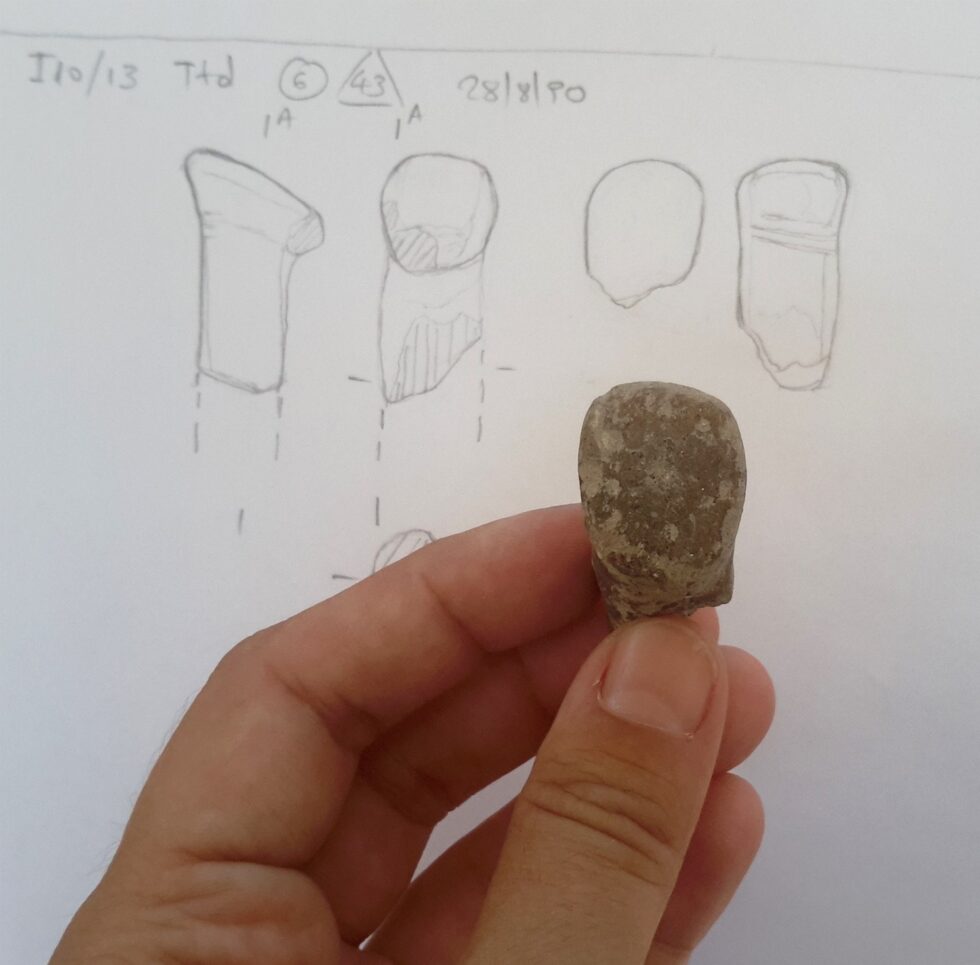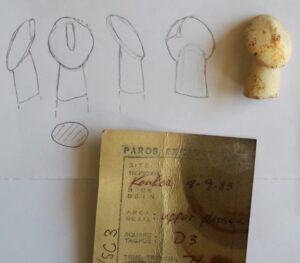

The site of Koukounaries on Paros is a naturally fortified hill, in the bay of Naousa. Although Mycenaean settlers and their successors established an acropolis with a fortification and a mansion as well as significant sanctuaries at various points on the hill up to the Archaic period—during the time of the Parian poet Archilochus—and leveled earlier architectural remains, many elements of the Neolithic and Early Bronze Age survived, scattered beneath later constructions or intact in certain areas.
Neolithic populations established post-built and rough-walled structures during the 5th and 4th millennia BCE. They used dark, polished ceramic vessels, many of which bear traces of red slip or crust, a characteristic of the period. Most vessels are bowls and jars, some featuring cord-impressed or relief decorations and decorative attachments. Some of the finds are chronologically placed at the end of the Neolithic and the transition to the Early Bronze Age, coinciding with the use of the Plastiras cemetery, a site in the bay near Koukounaries, where earlier excavations uncovered a collection of figurines with very distinctive characteristics.
After a hiatus of several centuries, new inhabitants of the Early Bronze Age (Early Cycladic II) constructed a small two-story building at the top of the hill. It included storage areas and a subterranean drainage system for rainwater. Marble figurine fragments from this period were found in the deposits of the Mycenaean structure—likely collected on the hill and stored by the Mycenaeans. Given that few prehistoric settlements in the Cyclades have been excavated compared to Cycladic cemeteries, Koukounaries provides valuable information about prehistoric residential space and settlement organization in the Cyclades.