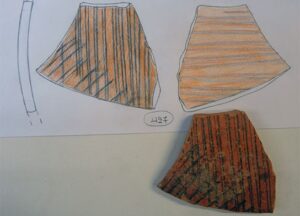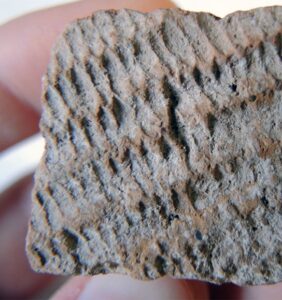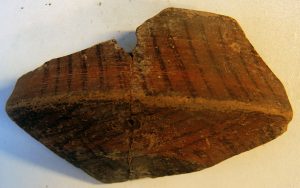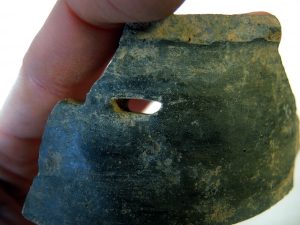
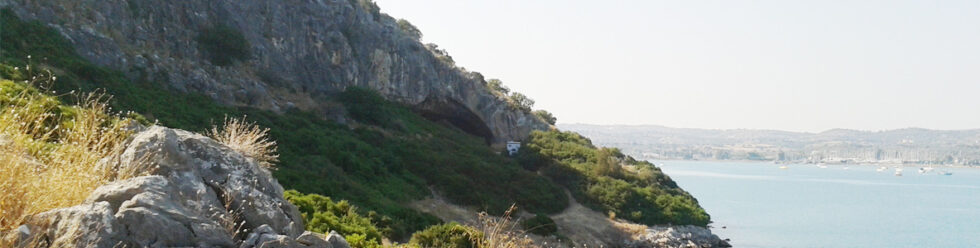
Recent ceramic finds from the Franchthi cave in the eastern Peloponnese, unearthed during the enhancement project that was sponsored by European funds, include a small sample of all pottery types known from the publication by the earlier American excavation project. Most of the new material spans the period between the 6th and the 4th millennium BC. The collection I have examined contains red-patterned vessels of the Middle Neolithic, painted Urfirnis of the early Late Neolithic and plain coarse and monochrome polished ware of the Final Neolithic.
The new material documents that the entire area outside the cave and along the coast as well as higher than the beach zone was occupied at least during the 6th millennium BC. The pottery confirms that local potters improved upon their firing skills, achieving very high temperatures and using raw materials which obtained lustrous effect on the container surface, without necessarily burnishing intensely (Urfirnis wares). Close, sherd-by-sherd observation reveals that shared decorative motifs and their general tendency to polychromy was expressed with unique variability. A characteristic pattern is the “brushstrokes” where the paintbrush becomes deliberately visible and creates intentional variation in pigment coloration and shades. Eventually, each vessel constitutes a unique combination of colors, tonalities, and decorative elements. The aesthetic and technical principles of the Urfirnis pottery influence the decorative themes of other vessels produced with more conventional slips in different regions. This influence extends as far as central and western Greece, as well as the Aegean, offering a vivid example of how Neolithic techniques and “imagies” travelled and were transformed across space.