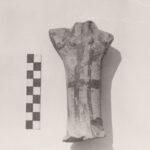

Nestor’s Cave preserves deposits from multiple chronological periods, including a Neolithic phase dating to the late 6th and 5th millennia BC. Distinct Neolithic finds include ceramic fragments of the Urfirnis-type, i.e. from vessels with an inherent gloss that results from a special composition of the initial slip rather than burnishing. The gloss is activated during firing, as has been better studied on examples from the Franchthi cave in the Argolid. Nestor’s Neolithic ceramic finds also include evidence of painted or incised decoration.
Later phases include the Bronze Age until the early historical times. Disturbances of the cave’s deposits by old illicit excavations have led to significant fragmentation of the cave’s finds and hinder understanding of spatial use. Nonetheless, it can be hypothesized that the activities were domestic during certain periods as well as ritual in others, especially in later Bronze Age phases and even later.
The collection of finds from Nestor’s cave derives from a series of excavations conducted at different periods, linking the site to key moments in the history of Greek archaeology. The most recent research took place in the early 1980s, as part of the excavation program of the University of Athens under Prof. Georgios S. Korres in the Voidhokilia area. Earlier work was carried out at the beginning of the 1950s by William A. McDonald as part of the University of Cincinnati excavations at Pylos under Carl Blegen. The young Dimitrios R. Theocharis also participated in these McDonald’s excavation. At an even earlier stage, Nestor’s cave intersects with the history of Homeric archaeology through the work of Heinrich Schliemann: in the late 19th century, Schliemann was among the first to excavate caves in Greece and investigated this cave and the mound with the building remains above it in search of evidence related to Mycenaean Pylos.