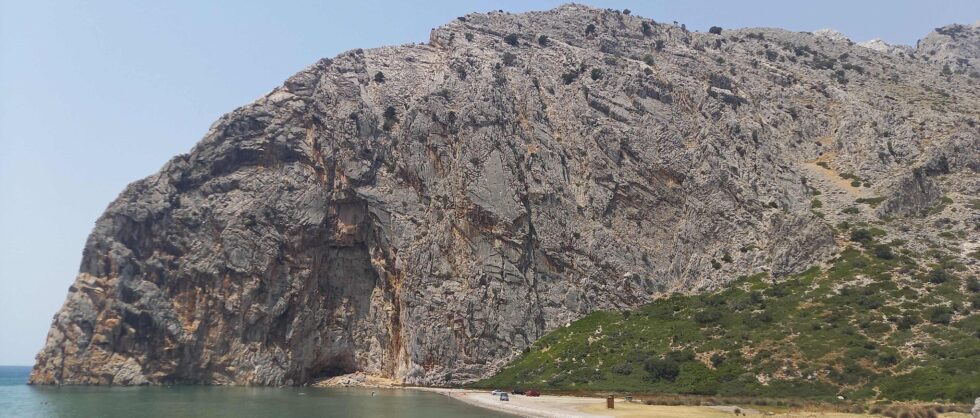
2025, Y. Facorellis, M. Fedi, M. Ntinou, E. Vardala-Theodorou, S. Katsarou, A. Darlas, Preliminary results on the calculation of the Marine reservoir effect during the Palaeolithic period based on samples from coastal caves in Karavostasi, Manis, Peloponnese, Greece, 9th Symposium for Archaeometry of the Hellenic Society for Archaeometry, “Materializing the Past: Narratives via Archaeological Science”, Patras, 5-8 November 2025, Institute of Chemical Engineering Sciences.
2025, S. Katsarou, A. Nagel, A. Karadima, Akarnania’s ancient caves in modern times: new archaeological research and material evidence, Interdisciplinary Studies in Ancient Western Greece and Beyond. Farewell to Franziska Lang, International Conference, Technical University of Darmstadt, 11-12 December 2025 (Organizer: Technical University of Darmstadt).
2025, S. Katsarou, Cave excavations and their contribution to understanding Greek prehistory, Half a Century of Cave Protection and Research. Symposium Dedicated to the Memory of Evangelia Protonotariou-Deilaki, Athens, Epigraphic Museum, 9 October 2025 (Organizer: Ephorate of Palaeoanthropology-Speleology). [in Greek]
2025, I. Efstathiou, S. Katsarou, A. Papadea, G. Valvis, Caves in the Ionian sea and western Greece: Human activity, new evidence and research perspectives, Half a Century of Cave Protection and Research. Symposium Dedicated to the Memory of Evangelia Protonotariou-Deilaki, Athens, Epigraphic Museum, 9 October 2025 (Organizer: Ephorate of Palaeoanthropology-Speleology). [in Greek]
2025, S. Katsarou, E. Karkazi, A. Darlas, Coast and karst dynamics: the case of Limnopoula rockshelter, Varassova, Nafpaktia, 6th International Maritime Archaeology Graduate Symposium (MAGS 2025), Ioannina, 2-5 April 2025 (Organizers: University of Ioannina & Honor Frost Foundation).
2024, S. Katsarou, K. Sporn, From Greece to Germany. The Ludwig Reisch collection and Palaeolithic research at the Kephalari cave in the Argolid, Archaeology & Arts 145 (August 2024), pp. 20-33. [in Greek]
2021, S. Katsarou, The art of carving in prehistoric period. In: Engraving. From Prehistory to Present-Day Greece. Exhibition. 29 December 2021-28 February 2022, Athens, School of Fine Arts, Chamber of Fine Arts of Greece. Exhibition Catalogue, pp. 13-15.
2021, S. Katsarou, A. Nagel, Introduction: On reading caves and ancient Greek cult. In: S. Katsarou, A. Nagel (eds.), Cave and Worship in Ancient Greece. New Approaches to Landscape and Ritual, pp. 1-16. London/New York. Routledge. https://doi.org/10.4324/9781003015765-1
2017, S. Katsarou, A. Darlas, Cave heritage in Greece: Aetoloakarnania, Archaeological Reports 63 (Archaeology in Greece 2016-2017), pp. 89-105. https://doi.org/10.1017/S057060841800008X
2010, S. Katsarou, A. Sampson, The Aegean Mesolithic: A hybrid culture, an outward society. In: A. Sampson (ed.), Mesolithic Greece, 9,000-6,500 BC, pp. 173-182. Athens. Ιon Publishing Group. [in Greek]
2009, S. Katsarou-Τzeveleki, Building and applying ‘Insularity Theory’: Review of Knapp’s Prehistoric and Protohistoric Cyprus, 2008, Mediterranean Archaeology and Archaeometry 9(1), pp. 123-128. https://www.maajournal.com/index.php/maa/article/view/291/230
2007, A. Sampson, S. Katsarou, The prehistory of Cyprus. In: A. Sampson, The Prehistoric Archaeology of the Mediterranean, pp. 317-351. Αthens. Editions Kardamitsas. [in Greek]
2006, Α. Σάμψων, Σ. Κατσαρού-Τζεβελέκη, Κύπρος. Η Εποχή του Λίθου και η Χαλκολιθική. Στο: Ιστορία των Ελλήνων, τόμος 15:Κύπρος. Αθήνα. Εκδόσεις Δομή. [in Greek]
2005, S. Katsarou-Tzeveleki, A. Sampson, The earliest habitation of Cyprus. The ‘Cypriot’ influence to the Aegean indigenous versus imported Neolithization debate. In: A. Sampson, Τhe Prehistory of the Aegean Basin. Palaeolithic-Mesolithic-Neolithic, pp. 88-114. Athens. Editions Atrapos. [in Greek]
2004, A. Sampson, S. Katsarou, Cyprus, Aegean and the Near East during the PPN, Neo-Lithics. The Newsletter of Southwest Asian Neolithic Research 1/04, pp. 13-15. https://www.exoriente.org/repository/NEO-LITHICS/NEO-LITHICS_2004_1.pdf
2001, S. Katsarou-Tzeveleki, Aegean and Cyprus in the Early Holocene: Brothers or distant relatives?, Mediterranean Archaeology and Archaeometry 1(1), pp. 43-55. https://www.maajournal.com/index.php/maa/article/view/19/8
2001, S. Katsarou, Aegean and Cyprus in the Early Holocene. Brothers or distant relatives?, The Aegean Basin between the Balkans, Anatolia and Near East: Local Experimentations and Outward Interactions in an Island Society, Rhodos, University of the Aegean, 23 March 2001 (Organizer: Department of Mediterranean Studies, University of the Aegean).
2000, S. Katsarou, Wall paintings and reliefs in the Pre-pottery and Pottery Neolithic of Anatolia and Mesopotamia, “Cultures of the Oriental Peoples,” 4th Prehistoric Archaeology Conference of the University of Ioannina, Ioannina, March 18-19, 2000 (Organizer: Department of Archaeology, University of Ioannina). Unpublished Proceedings; uploaded on www.academia.edu.[in Greek]